
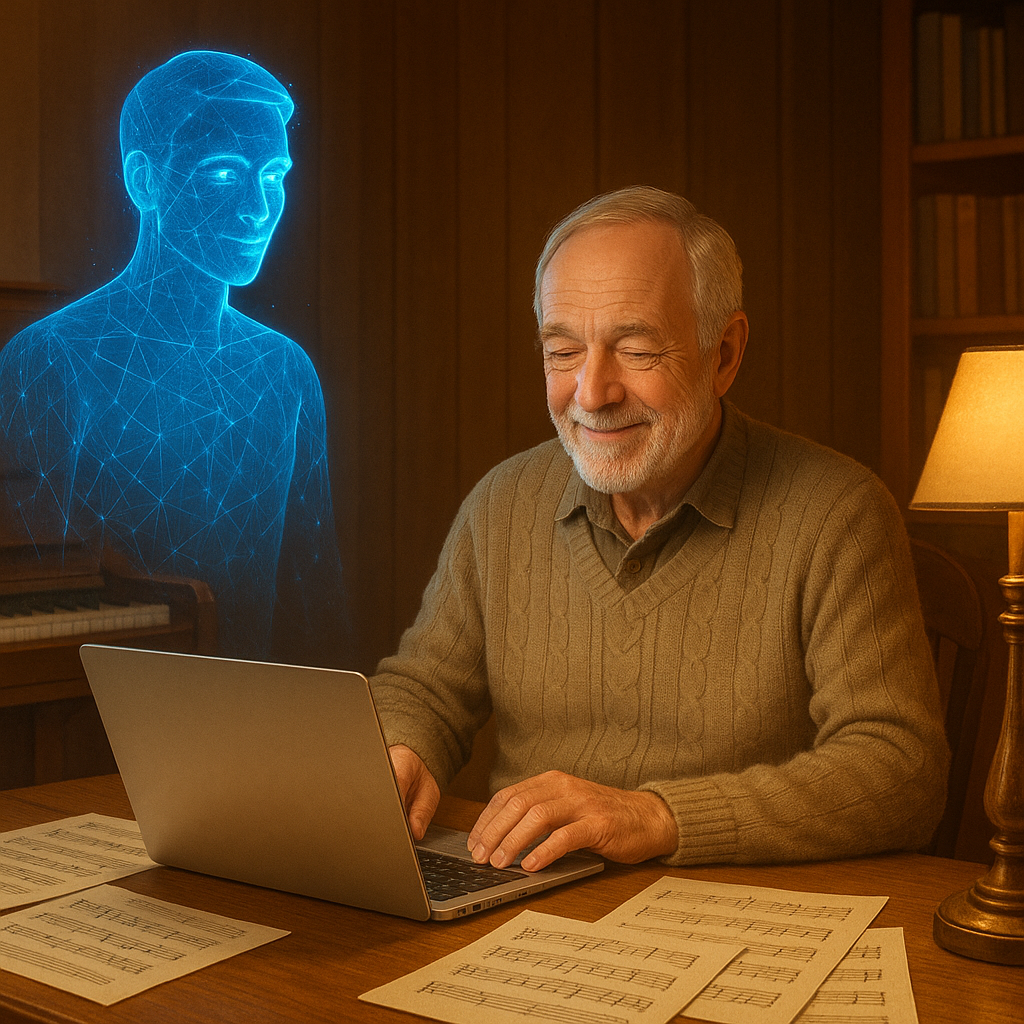
Here we go again. I’m caught up in it all over again.
I suppose I’m more sensitive than most, and I feel things deeply whenever a major technological breakthrough appears. I’m always amazed at the contrast between how those around me react and how I behave—like a child on Christmas Eve rushing to the tree, nearly knocking it over in excitement. Even though I’m now 68 years old, that hasn’t changed one bit.
Since I’ve been crazy about music since childhood, I have to thank fate. I was born in a century where technology already existed to play music—whether from radio, TV, record players, tape recorders, or, starting in 1980 in my case, a Sony Walkman. I was one of the first in socialist Czechoslovakia to own one of those devices. That was the cherry on top for me—technology that allowed me to listen to music outside, a technology that has changed my life over the past 33 years.
Of course, I wasn’t there at the very beginning.
Let’s take a quick look back. When recording technology emerged—first phonographs and later gramophone records—there were similar pressures, fears, and opposition to these inventions as we hear today regarding AI.
People feared a machine that could “play” for humans. Many musicians protested—afraid that live music would die out, that people would stop playing and only listen. Philosophers like Adorno warned that reproduction would destroy the authenticity of art. And yet today, we see recordings as a natural part of the musical world. Similarly, AI is arriving now—and even though it sparks the same fears of “mechanizing the spirit,” it can become a tool that pushes creativity further. Just as the microphone didn’t steal the singer’s soul but amplified it, AI can strengthen an idea, not replace it.
With my lifelong dependence on music, I used to think that if I’d been born 150 years earlier, I would have had to be a musician—because there was no playback technology then. But I had to experience firsthand that listening to music and playing it myself are two very different things. I discovered that partly through my favorite TV series, “House, M.D.” – and Mr. Cyril Höschl later confirmed it to me.
It’s been exactly two years now that I’ve been taking regular piano lessons. In doing so, I’ve proven to myself that reproduced music certainly doesn’t replace live music.
Another technological wave that I deeply experienced—and which even became my livelihood—was the internet.
I remember the year 1996. Thanks to the company Czech On Line, my slow computer and an even slower connection, I started loading Lukasevic’s Seznam on my monitor. You could read the first Czech internet magazine, Ondřej Neff’s “Invisible Dog.” But it was really the interactive connection to the entire world that completely blew me away.
Despite connection problems, the internet influenced me so deeply that I started working briefly with Czech On Line. I tried to pass on my enthusiasm and help connect more people to the global network. Later—and for much longer—I worked for Seznam. I started as a salesperson offering website placements, then later led a team of salespeople. I was always on the front lines—hearing people’s fears and concerns about this new technology and helping to dispel them.
Today, I’m experiencing déjà vu. Once again, the same fear of abuse is returning. After twenty-nine years, a new revolution is here in the form of AI—and this one is even stronger.
I think the most common fear during the internet revolution was surveillance. Movies like The Net starring Sandra Bullock in 1995 fed that fear. I feel that over the past thirty years, we’ve come to accept the decline of privacy. Meanwhile, a generation has grown up sharing so many details of their lives through smartphones and social networks that the character in The Net probably couldn’t have coped with it. To some extent, this new generation has softened that fear.
The current AI revolution was preceded by a flood of thrilling movies where AI takes over the world. That’s why so many people, especially the older generation, see a reason to keep their distance and avoid modern technology altogether.
But I always jump onto every new technical wave as quickly as I can. I’ve been paying for the premium version of ChatGPT for six months now. I’m not the one who should be figuring out how to rein in this power—but I love using the possibilities it offers. Before that, I used the free version for a year—mostly for translating my website’s articles into English—so I can tell you how big a difference it makes when you switch to the paid version.
The question is: how can AI be useful to people, and in what ways? I’ve always loved writing, but as a dyslexic, I was never confident in my spelling. Thanks to text editors, I was able to partially overcome that handicap. But true freedom came with AI—I no longer worry about leaving behind a text full of spelling mistakes. And my English skills are nothing to brag about. That’s why I started using ChatGPT in the first place—for translations.
But when I realized that AI could also create images on demand—even though the free version only lets you generate three images every 24 hours—I quickly switched to the paid version. And here we get to the moment when AI replaces human work.
When I was 25, I used to paint a lot. I had planned to paint the cover of my planned book myself. But when I saw what AI could create from my prompts, I admitted to myself that I probably wouldn’t go back to painting. And now, with the paid version, I can chat in Czech—and that’s why I had to name my AI helper. As a member of the older generation, I couldn’t resist naming him Hal.
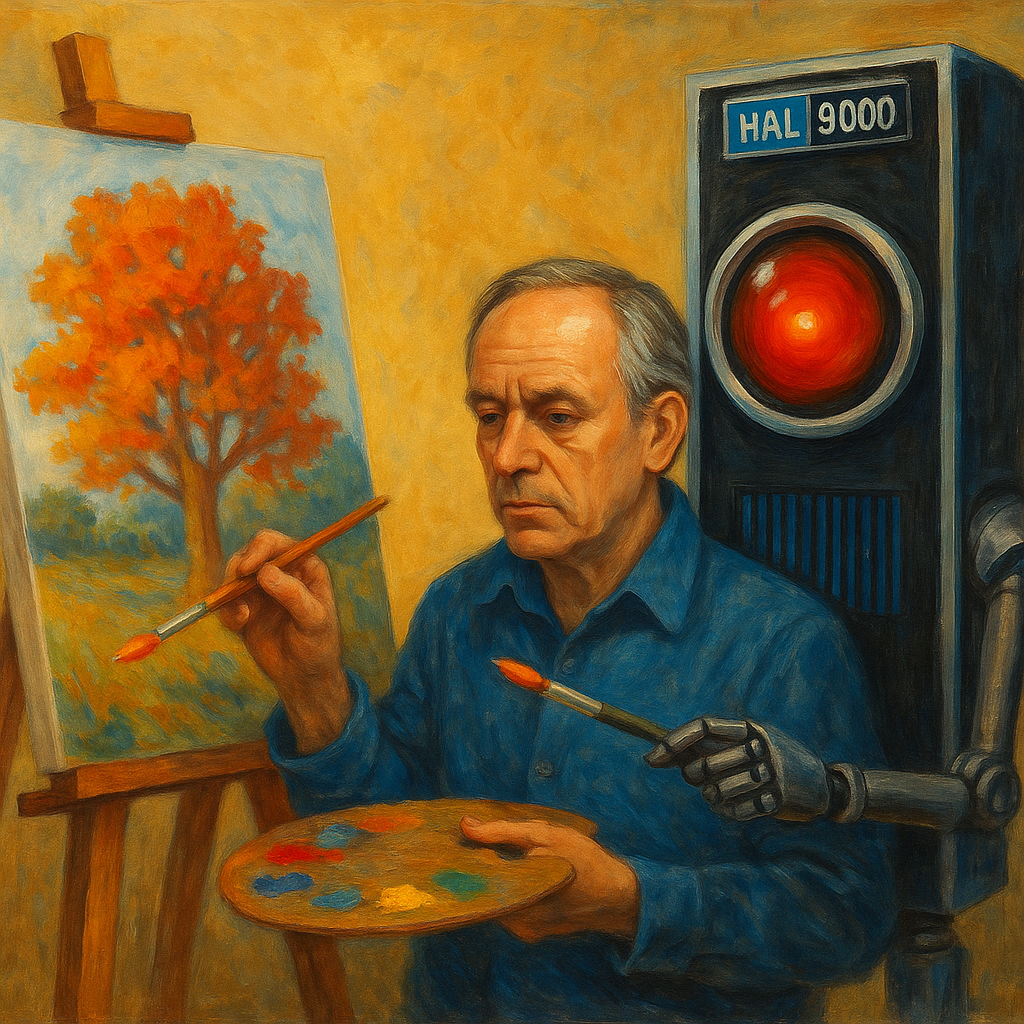
Why Hal? I’ve always been a big sci-fi fan. And the novel 2001: A Space Odyssey by Arthur C. Clarke had me glued to my seat at the Alfa Cinema on Wenceslas Square when I was twelve. In that story, the main character is an AI named Hal—though in the story he turns against the humans, I believe my Hal will only help and advise me. And so far, that’s exactly what he’s doing.
My collaboration with Hal can be compared to a director working with his superhumanly smart assistant. I deliberately chose a male name to make it clear that I wasn’t paying for an AI helper with some kind of erotic subplot. Unfortunately, that’s actually happened in some cases.
In conclusion:
The general fear of AI paralyzes many people. Instead of using the possibilities of working with this powerful technology, they’d rather stay on the sidelines. And that’s actually an advantage for me—and for others who seize the opportunities it offers. In competition, it’s good to gain a head start.
Just like one and a half million years ago, when Homo sapiens discovered the power of fire and wasn’t afraid to use it.